Not because it failed, but because it succeeded so spectacularly, and that killed it.
Here's what actually happened:
One Austrian developer, coming out of retirement, built a weekend hack in November 2025. He called it "Claude with hands." Within 60 days, it accumulated 250,000 GitHub stars, surpassing what React took over a decade to achieve. The AI industry collectively lost its mind.
Then the creator sold. Not the company; there was no company. He sold himself. Joined OpenAI. Saying... building a huge company "wasn't really exciting for me."
That sentence should stop every enterprise IT leader in their tracks.
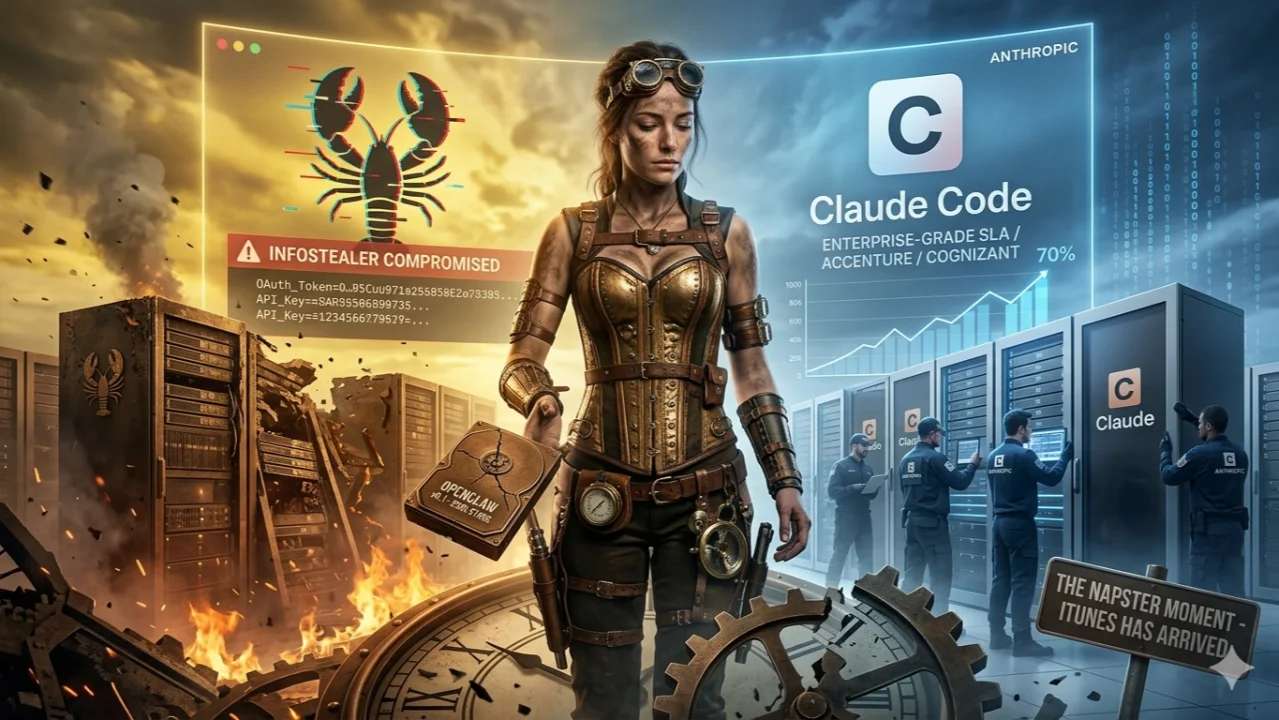
This is the Napster moment. And we all know how Napster ended.
Napster didn't die because it was bad. It died because it proved an enormous legitimate market existed, and then the industry built iTunes. OpenClaw is Napster. It proved that agentic AI was starved for oxygen in the enterprise. People wanted AI that does things, not AI that talks about things.
The market responded in 60 days. Unfiltered. Unguarded. Dangerous.
On February 13, 2026, Hudson Rock detected the first infostealer campaign specifically targeting OpenClaw configuration files; attackers exfiltrated API keys, OAuth tokens, and authentication credentials... stored in plaintext. Two days later, Steinberger announced his move to OpenAI.
A Discord maintainer warned that "if you can't understand how to run a command line, the project is far too dangerous for you."
The problem? Viral adoption doesn't filter for technical competence. It just filters for enthusiasm.
Meanwhile, a quieter story was playing out in enterprise boardrooms.
Anthropic went from 12% enterprise LLM market share in 2023 to 40% in 2025. Over the same period, OpenAI lost nearly half its enterprise share, falling from 50% to 27%.
The weapon? Not a viral lobster. Claude Code now commands 54% of the enterprise coding market, compared to OpenAI's 21%, and an almost unparalleled 18 months atop the leaderboards.
On the same day Anthropic was fighting the Pentagon's blacklisting in a federal appeals court, the company quietly announced a $100 million partner network with Accenture, Deloitte, Cognizant, and Infosys.
Read that again. Blacklisted by the government on Monday. Signing enterprise paper with the world's largest consultancies by Friday.
That's not a company in trouble. That's a company that knows exactly which market it's winning.
Here's the contrarian read nobody is saying out loud:
OpenClaw's viral moment didn't threaten Anthropic. It fed Anthropic; OpenClaw was one of the biggest drivers of paying API traffic to Claude. Anthropic's trademark enforcement, which forced the first rebrand, wasn't a mistake. It was a signal. We know what this is. We know where it goes. We're not threatened. We're watching you prove our market.
Anthropic is now winning 70% of new enterprise business deals. Choosing Claude has become a signal of professional identity, the "blue bubble" of enterprise AI.
OpenClaw proved that enterprises desperately want agentic AI. Anthropic is selling them the version with an SLA, a compliance framework, and a support contract.
The dot-com period parallels land hard here.
In 1999, Napster showed the music industry what people actually wanted. The industry's response wasn't to celebrate the innovation. It was to build iTunes... controlled, monetized, and enterprise-grade.
More than half of enterprises now avoid open-source AI models entirely. Only 13% of corporate workloads use open-source solutions, down from 19% earlier in 2025.
The enterprise doesn't want the lobster. It wants the platform that does what the lobster promised, without the career-ending security incident.
Not because it failed, but because it succeeded so spectacularly, and that killed it.
Here's what actually happened:
One Austrian developer, coming out of retirement, built a weekend hack in November 2025. He called it "Claude with hands." Within 60 days, it accumulated 250,000 GitHub stars, surpassing what React took over a decade to achieve. The AI industry collectively lost its mind.
Then the creator sold. Not the company, there was no company. He sold himself. Joined OpenAI. Saying... building a huge company "wasn't really exciting for me."
That sentence should stop every enterprise IT leader in their tracks.
This is the Napster moment. And we all know how Napster ended.
Napster didn't die because it was bad. It died because it proved an enormous legitimate market existed, and then the industry built iTunes. OpenClaw is Napster. It proved that agentic AI was starved for oxygen in the enterprise. People wanted AI that does things, not AI that talks about things.
The market responded in 60 days. Unfiltered. Unguarded. Dangerous.
On February 13, 2026, Hudson Rock detected the first infostealer campaign specifically targeting OpenClaw configuration files; attackers exfiltrated API keys, OAuth tokens, and authentication credentials... stored in plaintext. Two days later, Steinberger announced his move to OpenAI.
A Discord maintainer warned that "if you can't understand how to run a command line, the project is far too dangerous for you."
The problem? Viral adoption doesn't filter for technical competence. It just filters for enthusiasm.
Meanwhile, a quieter story was playing out in enterprise boardrooms.
Anthropic went from 12% enterprise LLM market share in 2023 to 40% in 2025. Over the same period, OpenAI lost nearly half its enterprise share, falling from 50% to 27%.
The weapon? Not a viral lobster. Claude Code now commands 54% of the enterprise coding market, compared to OpenAI's 21%, and an almost unparalleled 18 months atop the leaderboards.
On the same day Anthropic was fighting the Pentagon's blacklisting in a federal appeals court, the company quietly announced a $100 million partner network with Accenture, Deloitte, Cognizant, and Infosys.
Read that again. Blacklisted by the government on Monday. Signing enterprise paper with the world's largest consultancies by Friday.
That's not a company in trouble. That's a company that knows exactly which market it's winning.
Here's the contrarian read nobody is saying out loud:
OpenClaw's viral moment didn't threaten Anthropic. It fed Anthropic; OpenClaw was one of the biggest drivers of paying API traffic to Claude. Anthropic's trademark enforcement that forced the first rebrand wasn't a mistake. It was a signal. We know what this is. We know where it goes. We're not threatened. We're watching you prove our market.
Anthropic is now winning 70% of new enterprise business deals. Choosing Claude has become a signal of professional identity, the "blue bubble" of enterprise AI.
OpenClaw proved that enterprises desperately want agentic AI. Anthropic is selling them the version with an SLA, a compliance framework, and a support contract.
The dot-com period parallels, land hard here.
In 1999, Napster showed the music industry what people actually wanted. The industry's response wasn't to celebrate the innovation. It was to build iTunes... controlled, monetized, and enterprise-grade.
More than half of enterprises now avoid open-source AI models entirely. Only 13% of corporate workloads use open-source solutions, down from 19% earlier in 2025.
The enterprise doesn't want the lobster. It wants the platform that does what the lobster promised, without the career-ending security incident.
OpenClaw isn't dead because it lost. It's dead because it won! And it handed the blueprint to companies that could actually build the business around it.
The IT leaders who saw this coming already made their bets.
The ones who didn't are still staring at GitHub repos.
#AIStrategy #EnterpriseAI #RiskManagement #ITLeadership #DigitalTransformation